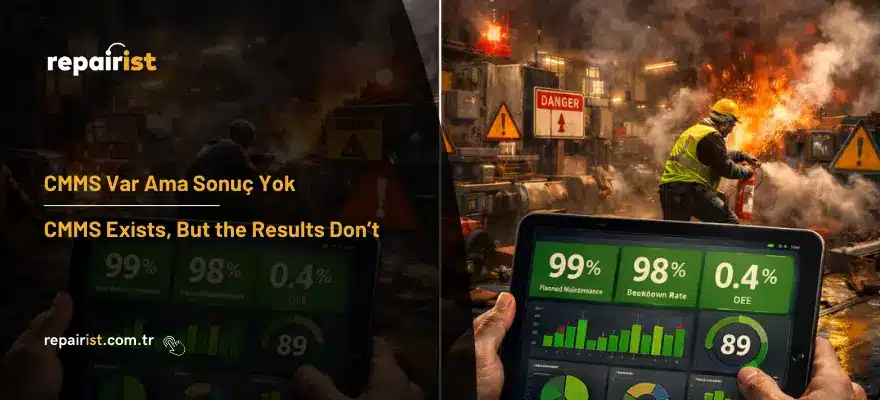

Maintenance KPIs are meant to create transparency and guide decisions. Dashboards are filled with completion rates, percentages, and indicators that suggest maintenance is under control. Yet in many facilities, the shop floor reality tells a different story. Breakdowns repeat, urgent work never disappears, and teams remain reactive despite “successful” reports.
This gap exists because most KPIs measure what is easy to count, not what truly matters in maintenance execution.

KPIs Measure Activity, Not Maintenance Quality
Most maintenance KPIs focus on volume-based metrics. These indicators track activity, not effectiveness.
Commonly tracked KPIs include:
- Number of closed work orders
- Preventive maintenance completion rate
- Planned vs. unplanned work ratio
- Average response or closure time
While useful on paper, these KPIs do not answer critical questions such as:
- Was the right task performed?
- Did the maintenance action eliminate the root cause?
- Did equipment reliability improve after execution?
As long as KPIs are disconnected from maintenance quality, performance will look better than it actually is.
Closed Work Orders Don’t Mean Completed Maintenance
In many organizations, work orders are closed to reduce backlog pressure or keep dashboards green. Execution details are often minimal, and verification steps are skipped.
Typical symptoms include:
- Work orders closed without field validation
- Missing comments, measurements, or photos
- No confirmation that the task was executed as planned
When closure becomes the goal instead of correct execution, KPIs lose credibility. Reports show success, while failures continue to repeat.
Repetitive Failures Are Invisible in KPI Dashboards
Traditional KPIs are not designed to capture repetition. A recurring failure may generate multiple work orders, all of which are closed on time. From a KPI perspective, performance looks strong.
What KPIs often fail to show:
- The same asset failing multiple times
- Temporary fixes replacing permanent solutions
- Maintenance actions that treat symptoms, not causes
As a result, organizations celebrate green dashboards while operational risk silently increases.
Bad Data Creates Good-Looking KPIs
KPIs depend entirely on data quality. When work orders are rushed, copied, or closed without accurate details, the data feeding KPI calculations becomes unreliable.
Poor data quality typically comes from:
- Lack of execution standards
- No mandatory fields for critical information
- Absence of field-level verification
When unreliable data enters the system, KPIs become cosmetic indicators rather than decision-support tools.
KPI Tracking vs. Execution Control
| KPI-Focused Approach | Execution-Controlled Approach |
|---|---|
| Tracks closed work orders | Verifies work execution in the field |
| Measures quantity | Measures effectiveness |
| Relies on system status | Relies on real execution data |
| Green dashboards | Fewer recurring failures |
| Reactive decisions | Preventive, informed decisions |
This comparison highlights a critical truth: tracking KPIs alone does not improve maintenance. Control over execution does.
From Reporting to Real Maintenance Control
Maintenance KPIs should support decisions, not hide problems. Real performance improvement starts when organizations combine KPIs with execution discipline, verification mechanisms, and meaningful data collection.
When maintenance execution is controlled and validated, KPIs become powerful tools that reflect reality instead of masking it.

Next Steps
Have you received sufficient information about “Why Maintenance KPIs Don’t Reflect Reality”
repairist is here to help you. We answer your questions about the Maintenance Management System and provide information about the main features and benefits of the software. We help you access the repairist demo and even get a free trial.
Aybit Technology Inc.