
The Building Blocks of Modern Maintenance Management
In today’s industrial facilities, maintenance management is no longer limited to responding to equipment failures. Increasing production pressure, rising asset costs, occupational safety risks, and regulatory requirements make it essential to manage maintenance activities in a controlled, measurable, and sustainable way.
At this point, a CMMS (Computerized Maintenance Management System) becomes the core system that digitalizes and centrally manages maintenance operations. The true value of a CMMS lies in its modular architecture. Each CMMS module addresses a specific maintenance need, and together they provide full operational visibility and control.

Business Benefits of a Modular CMMS Structure
Thanks to its modular design, CMMS enables organizations to
- standardize maintenance processes
- reduce operational risks
- measure maintenance performance using quantitative data
- control maintenance budgets effectively
- transition from reactive to proactive maintenance strategies
Especially in asset-intensive industries, CMMS modules transform maintenance from a support function into a strategic operational discipline.
Core CMMS Modules and Their Functions
Asset and Equipment Management Module
This module forms the foundation of the CMMS. All machines, equipment, and infrastructure assets within the facility are digitally registered and structured.
Key benefits
- asset hierarchy and location-based structuring
- technical documentation, warranty, and certification tracking
- complete maintenance history per asset
- asset lifecycle management
This module provides clear insight into which assets generate the highest maintenance costs.
Work Order Management Module
The central control point of maintenance operations. All maintenance activities are managed through work orders.
Key benefits
- planned, corrective, and emergency work orders
- priority and SLA-based tracking
- technician and team assignment
- work order duration and performance analysis
Work order management ensures transparency and accountability across maintenance processes.
Preventive and Planned Maintenance Module
Ensures systematic execution of maintenance activities.
Key benefits
- time-based and meter-based maintenance plans
- automatic work order generation
- standardized maintenance checklists and procedures
- prevention of missed or delayed maintenance
This module plays a critical role in reducing unplanned downtime.
Breakdown and Maintenance Request Management Module
Allows operators and field personnel to submit maintenance requests digitally.
Key benefits
- failure classification
- identification of recurring breakdowns
- data support for root cause analysis
- effective maintenance prioritization
As failure causes become visible, maintenance strategies can be optimized accordingly.
Spare Parts and Inventory Management Module
Covers the management of spare parts that are essential for maintenance continuity.
Key benefits
- stock level monitoring and minimum stock definitions
- spare part consumption tracking
- spare part cost analysis per asset
- automatic linkage between work orders and inventory
This module reduces both inventory costs and downtime risks.
Maintenance Cost Management Module
Makes the financial impact of maintenance activities fully transparent.
Key benefits
- labor, spare part, and external service cost tracking
- asset-based maintenance cost analysis
- budget versus actual cost comparisons
Maintenance decisions can be evaluated based on their financial outcomes.
Advanced CMMS Modules
Mobile CMMS
Enables real-time participation of field teams in maintenance processes.
Offline functionality, photo uploads, and notes improve data accuracy and response speed.
Reporting and KPI Management
Tracks critical indicators such as MTBF, MTTR, maintenance compliance, and team performance.
Provides management dashboards for data-driven decision-making.
Audit and Compliance Management
Digitally manages legal maintenance records, periodic inspections, and certification processes.
Condition-Based and Predictive Maintenance
Monitors equipment health using IoT and sensor data.
Maintenance actions are planned before failures occur.
Integration and User Authorization
Ensures seamless data exchange with ERP, MES, and other enterprise systems.
Role-based access and authorization structures are defined.
CMMS Modules Summary Table
| Module | Business Value |
|---|---|
| Asset Management | Asset lifecycle and cost control |
| Work Order Management | End-to-end maintenance traceability |
| Preventive Maintenance | Reduced unplanned downtime |
| Breakdown Management | Analysis of recurring failures |
| Inventory Management | Spare part cost optimization |
| Mobile CMMS | Faster and more accurate field operations |
| KPI and Reporting | Data-driven maintenance decisions |
| Compliance Management | Regulatory compliance and audit readiness |
Next Steps
Have you received sufficient information about “CMMS Modules”
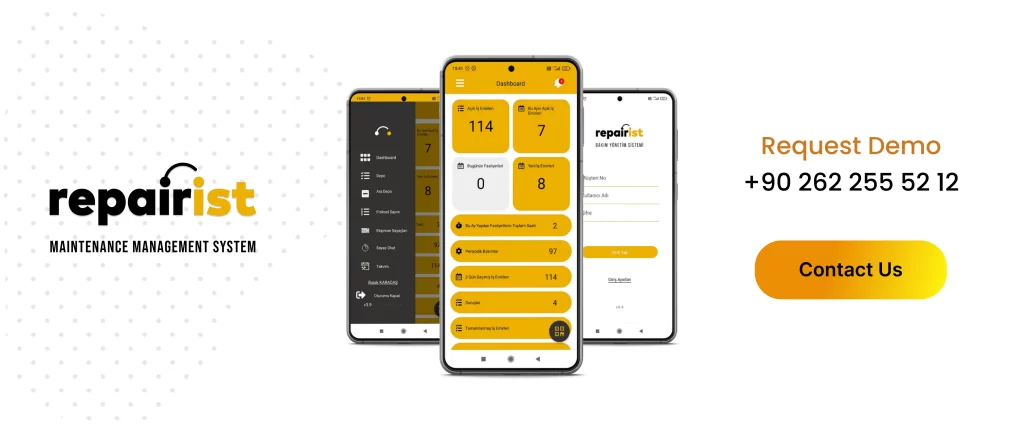
repairist is here to help you. We answer your questions about the Maintenance Management System and provide information about the main features and benefits of the software. We help you access the repairist demo and even get a free trial.
Aybit Technology Inc.
Frequently Asked Questions
Yes. Thanks to its modular structure, organizations can use only the modules they require.
No. Production, quality, procurement, and executive management teams also benefit from CMMS.
Yes. Its scalable architecture makes it suitable for facilities of all sizes.