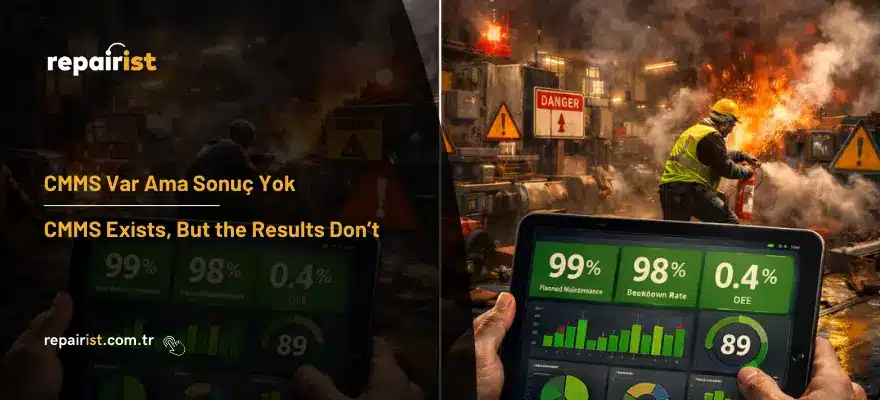
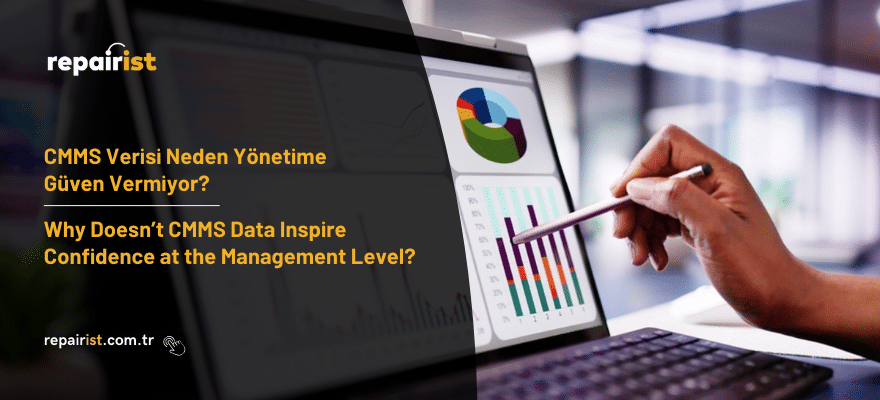
Maintenance teams enter data into the CMMS every day. Work orders are closed, maintenance plans run, and reports are generated. Yet one critical question always remains on the table: With so much data available, why is management still unable to make clear decisions? In most cases, the problem is not the CMMS itself. The problem lies in how the data is presented to management.

CMMS Data Exists — So Why Is There No Trust?
In many facilities, maintenance managers present CMMS reports, yet senior management still asks for Excel files.
This is not because the data is incomplete, but because it fails to create meaning. Management wants clear answers to simple questions:
- Were maintenance activities actually completed?
- Has risk been reduced?
- Are costs under control?
Most CMMS reports, however, focus only on activity, not impact.
The Problem Is Not the Data, but How It Is Interpreted
KPIs Are Operational, Not Managerial
KPIs such as MTTR, MTBF, and planned maintenance ratio are valuable for maintenance teams.
But if management cannot see how these numbers affect the business, they do not build trust. For example:
MTTR has decreased — but has production loss also decreased?
Planned maintenance has increased — but has failure risk actually gone down? When these questions remain unanswered, KPIs turn into numbers that look good but do not drive decisions.
Reports Show Activity, Not Outcomes
The number of work orders closed or maintenance tasks completed in a month is not meaningful on its own for management.
Because these figures do not answer the real question:
Was maintenance performed at the right place, at the right time? Activity reports create records — not decisions.
Why Don’t CMMS Reports Provide Decision Support?
Too Many Reports, Too Little Insight
Many CMMS platforms offer dozens of different reports. But as the number of reports increases, insight often decreases. Crowded dashboards do not deliver a clear message to management. On the contrary, they reduce confidence.
Lack of a Time Dimension
One-off reports show only the current moment. Management, however, wants to see trends. Is maintenance performance improving? Is risk increasing or decreasing? Did corrective actions actually work? Data without a time dimension cannot create trust.
What Should CMMS Data That Management Trusts Look Like?
Reports That Tell a Story
An effective CMMS report for management should answer four questions:
- What was the problem?
- Why did it occur?
- What did we do?
- What was the result? If data does not tell a story, it cannot support decisions.
KPIs Must Speak the Language of Business
Maintenance KPIs gain real meaning when they are linked to business objectives such as:
- production continuity,
- food safety,
- cost control,
- risk reduction.
Management trusts maintenance data only when it is presented in this language.
CMMS: A Reporting Tool or a Decision Support System?
When a CMMS is used only as a record-keeping system, data does not build trust.
But when designed correctly, a CMMS can:
- make maintenance risks visible,
- clarify priorities,
- give management the confidence to take action. The difference is not in the software it is in the perspective.
Data That Is Not Trusted Is Data That Is Not Used
Data that management does not trust does not lead to decisions. And data that does not lead to decisions is eventually ignored. he true value of a CMMS lies not in producing data, but in enabling the right decisions. The day maintenance data earns management’s trust, CMMS stops being just a software tool and becomes a strategic asset.

Next Steps
Have you received sufficient information about “Why Doesn’t CMMS Data Inspire Confidence at the Management Level?”
repairist is here to help you. We answer your questions about the Maintenance Management System and provide information about the main features and benefits of the software. We help you access the repairist demo and even get a free trial.
Aybit Technology Inc.