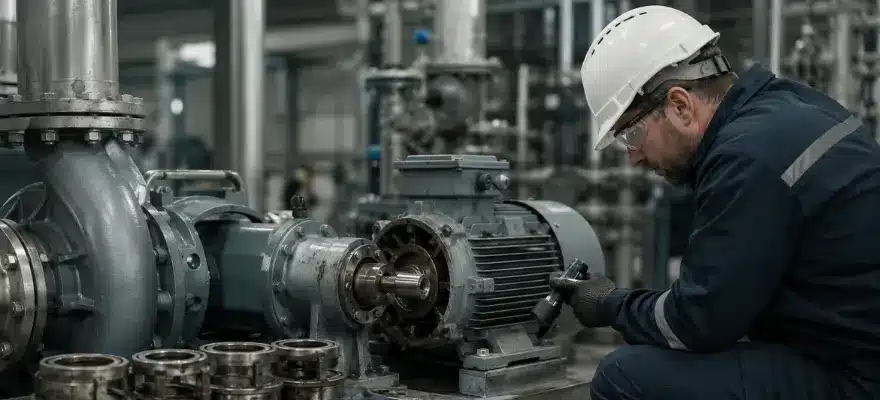

Important information in maintenance operations is not created only through reports or work orders. Observations made by technicians during their shifts, ongoing interventions, parts awaiting procurement, and temporary measures are also important parts of the maintenance process.
Incomplete transfer of this information to the next shift can turn a minor communication problem into a serious operational risk.
- “The machine is currently running, but there is noise coming from the bearing.”
- “The failure has been temporarily resolved, but the part must be replaced.”
- “The work order has been created, but the required material has not yet arrived from the warehouse.”
When such critical information is communicated verbally, it may be forgotten, misunderstood, or not recorded at all. Especially in facilities operating with multiple shifts, maintenance continuity cannot depend only on technicians’ experience and personal notes.
A maintenance shift handover form ensures that a maintenance process started during one shift continues in a controlled manner during the next shift. Managing the form digitally helps open tasks, equipment conditions, and responsibilities to be monitored through a centralized system.

What Is a Maintenance Shift Handover?
A maintenance shift handover is the process in which the outgoing maintenance team transfers technical information generated during the shift to the incoming team.
This process is not limited to communicating unfinished tasks. An effective handover process should include the following information:
- Ongoing equipment failures
- Open and pending work orders
- Temporary solutions that have been applied
- Risks affecting production or occupational safety
- Spare parts that must be used or procured
- Tasks awaiting external service
- Equipment that must be inspected
- Actions to be performed during the next shift
- Important maintenance tasks completed during the shift
Transferring this information completely prevents the incoming shift from investigating the same problems again. The maintenance team can continue from where the previous team stopped, reducing time losses during the intervention process.
Why Is a Verbal Shift Handover Risky?
In many businesses, shift information is still transferred through face-to-face conversations, messaging applications, notebooks, or separate Excel files.
These methods may appear fast in the short term. However, as maintenance operations grow, tracking information becomes more difficult.
Information remains dependent on individuals
Technical information that exists only in the relevant employee’s memory does not create a corporate record.
When an employee is on leave, arrives late for a shift, or changes responsibilities, important information may be lost.
Open tasks may be forgotten
Equipment may have been restarted before a failure was completely resolved. However, when the temporary solution is not recorded, the need for a permanent intervention may be forgotten.
This may cause the same failure to reappear as a more serious problem.
Responsibilities become unclear
When it is not clear who will perform the next action, the task may be continuously postponed between shifts.
Statements such as “I thought the previous shift would handle it” or “I assumed the task had been completed” are results of insufficient records and unclear responsibilities.
The maintenance history remains incomplete
Information transferred verbally is not added to the equipment’s maintenance history.
For this reason, recurring failures, temporary interventions, and changes in the equipment’s operating conditions cannot be analyzed later.
Occupational safety risks may arise
If information about equipment whose guard has been removed, which has been temporarily disabled, or which is operating under controlled conditions does not reach the next shift, serious safety problems may occur.
What Should Be Included in a Maintenance Shift Handover Form?
A standardized form ensures that the same types of information are recorded during every shift. This prevents the quality of the handover process from changing from one person to another.
| Information field | Why is it necessary? | Example |
|---|---|---|
| Date and shift | Identifies the time of the record | July 29, 2026 – Night shift |
| Equipment information | Identifies the relevant asset | Packaging Line – Conveyor 02 |
| Failure or task description | Explains the work performed | An increase in motor temperature was observed |
| Current equipment condition | Shows the operating condition | Operating under controlled conditions |
| Open work order | Enables the task to be tracked in the system | WO-2026-1458 |
| Temporary solution applied | Identifies an intervention that is not permanent | Fan cleaned; bearing must be replaced |
| Spare part awaited | Shows the reason for the delay | Awaiting 6205 bearing |
| Risk and priority | Defines the urgency of the task | High priority |
| Next action | Clarifies the incoming shift’s responsibility | Bearing will be replaced during the first shutdown |
| Responsible person | Determines task ownership | Mechanical maintenance team |
| Photograph or document | Supports the technical condition | Photograph of the motor temperature display |
Having too many fields in the form is also not appropriate. Extremely long forms may cause employees to create incomplete or careless records.
The purpose is to collect the critical information needed by the maintenance team through the simplest and most standardized structure possible.
How Is a Digital Shift Handover Process Established?
Digitizing a maintenance shift handover form does not only mean transferring a paper form to a computer environment.
True digitalization requires shift information to be connected with equipment, work orders, maintenance personnel, and spare-part records.
Open tasks should be connected to work orders
Every ongoing maintenance task should have a traceable work order.
The work order should include the equipment, failure description, responsible technician, priority, current status, and planned action. This ensures that the information does not remain only in the shift note and can be tracked through the system until completion.
Equipment conditions should be standardized
Standard conditions such as “operational,” “operating under controlled conditions,” “awaiting maintenance,” “out of service,” or “awaiting external service” can be used.
Standard condition definitions allow the incoming shift to understand the equipment risk quickly.
Temporary solutions should be identified separately
Restarting equipment does not necessarily mean that the maintenance task has been completed.
Temporary interventions should be specifically marked, and a new task should be created for the permanent solution.
Notifications should be sent automatically
A high-priority task can be automatically assigned or communicated to the responsible person on the incoming shift.
This makes critical tasks visible without requiring maintenance employees to review every note manually.
Handover records should be approved
Identifying the employee transferring the information and the employee receiving it clarifies responsibility within the process.
An approval mechanism is not only a control tool. It also provides corporate traceability.
Information Continuity Between Shifts with Repairist
Repairist Maintenance Management System helps maintenance requests and work orders to be created, assigned, and tracked through a centralized platform.
Maintenance managers can view open tasks, overdue activities, responsible personnel, and equipment histories through a single system. Through mobile access, technicians can also record maintenance information directly in the field.
This structure creates a centralized flow of information instead of using fragmented communication channels during shift changes.
Visibility of open work orders
Unfinished tasks remain open in the system. The incoming shift can see which tasks are continuing and their current stages.
Access to equipment history
A technician starting the new shift can review previous activities and historical failure records related to the equipment.
This prevents the same inspections from being repeated and enables the intervention process to continue with more accurate information.
Responsible-person and priority tracking
Responsible personnel and priority levels can be assigned to work orders.
The maintenance manager can prevent critical tasks from remaining unassigned or low-priority activities from being handled before important failures.
Mobile recording
Technicians can enter descriptions, photographs, and activity information into the system while working in the field.
Instead of trying to remember and record all information at the end of the shift, employees can create records at the time the activity takes place.
Centralized reporting
Tasks transferred between shifts, overdue work orders, and recurring failures can be reported.
This enables maintenance managers to evaluate not only daily tasks but also the overall performance of the handover process.
Which Indicators Should Be Monitored During Maintenance Shift Handovers?
Specific indicators should be monitored to understand whether the digital handover process is effective.
The main indicators include:
- Number of open tasks transferred between shifts
- Number of high-priority open tasks
- Number of machines operating with temporary solutions
- Work orders that are not completed on time
- Tasks reassessed because of incomplete information
- Maintenance tasks awaiting spare parts
- Tasks transferred across multiple shifts
- Average intervention time by shift
- Rate of reopened work orders
When a maintenance task is continuously transferred across different shifts, technician performance should not be the only factor evaluated.
Spare-part shortages, production schedules, external service requirements, or authorization problems preventing the task from being completed should also be analyzed.
Maintenance Information Should Not Be Lost During Shift Changes
A maintenance shift handover may appear to be a routine administrative task, but it is a critical process for production continuity.
Incomplete failure information may extend the intervention time. An unrecorded temporary solution may cause recurring failures. An unclear responsibility may lead to an important maintenance task being postponed for days.
With a standardized and digital maintenance shift handover form, open tasks, equipment conditions, technical risks, and next actions can be monitored centrally.
Next Steps
Have you received sufficient information about “Maintenance Request Management”?
repairist is here to help you. We answer your questions about the Maintenance Management System and provide information about the main features and benefits of the software. We help you access the repairist demo and even get a free trial.
Aybit Technology Inc.
Frequently Asked Questions
A maintenance shift handover form is a record structure that allows completed, ongoing, or pending maintenance tasks to be transferred to the next shift. Equipment conditions, open work orders, temporary solutions, risks, and next actions may be included in this form.
Digital records prevent information from being lost, allow open tasks to be tracked together with their responsible personnel, and support the creation of a complete equipment history. Maintenance managers can also view tasks transferred between shifts through a centralized system.
Not every notification may require a separate work order. However, every activity requiring technical intervention, part replacement, follow-up, or approval should be converted into a work order. This allows responsibility and status to be monitored until the task is completed.