
Importance of Legal Regulations
What Are Legal Regulations? General Framework
Maintenance management is the entirety of planned activities carried out to ensure the safe, efficient, and uninterrupted operation of equipment, machinery, and facilities within businesses. However, maintenance activities are not only an operational necessity but also a legal obligation. Especially for manufacturing plants, power stations, food facilities, chemical plants, and heavy industry organizations, maintenance processes must be conducted in compliance with specific regulations.
In Türkiye, the main regulations that directly or indirectly affect maintenance activities include:
- Occupational Health and Safety Law No. 6331,
- Regulation on Health and Safety Conditions in the Use of Work Equipment,
- Environmental and energy efficiency legislation,
- Sector-specific technical standards and regulations,
- ISO 55000 Asset Management standards.
These regulations aim to ensure equipment safety, reduce employee risks, and maintain operational continuity.

Impact on Maintenance Strategies
Legal regulations directly shape the maintenance strategies of businesses. While reactive maintenance approaches, where intervention occurred only after a failure, were common in the past, regulations today encourage businesses to adopt more proactive methods.
Due to legal requirements, businesses are obligated to:
- Create periodic maintenance plans,
- Conduct regular inspections of critical equipment,
- Store maintenance records and ensure traceability,
- Perform risk assessments,
- Carry out inspection and verification processes through authorized personnel.
Therefore, preventive maintenance, predictive maintenance, and risk-based maintenance approaches are becoming increasingly preferred today. Maintenance strategies that comply with regulations not only prevent legal penalties but also extend equipment lifespan, reduce unplanned downtime, and improve occupational safety performance.
Digital maintenance management systems (CMMS) also play an important role in this process. By tracking maintenance records digitally, businesses become more prepared for audits and can manage legal compliance more effectively.
Latest Legal Regulations in the Industry
Regulations published at the end of 2025 introduced significant changes to maintenance management processes. In particular, amendments to the Regulation on Health and Safety Conditions in the Use of Work Equipment closely concern maintenance teams and facility managers.
The prominent changes are as follows:
1. Clarification of the Scope of Periodic Inspections
With the new regulation, it has been clearly defined that only the equipment specified in Annex III of the regulation is subject to mandatory periodic inspections. This enables businesses to determine more clearly which equipment is legally required to undergo inspections.
2. Integration of İSG-KATİP and EKİPNET
To digitally record periodic inspection processes, the İSG-KATİP and EKİPNET systems have been made more effective. It has become mandatory to establish contracts through the system before inspection services, aiming to centrally track records.
3. Electronic Records and E-Signature Usage
The legal acceptance of storing maintenance and inspection reports with secure electronic signatures has been introduced. This change accelerates digital transformation processes while increasing the importance of maintenance management software.
4. New Requirements for Critical Infrastructure Inspections
Project and technical documentation requirements have gained greater importance in periodic inspections of critical infrastructures such as fire protection systems, ventilation systems, electrical installations, grounding systems, and lightning protection systems.
How Do Compliance Processes with Legal Regulations Work?
Managing Legal Compliance in Maintenance Processes
Legal compliance processes in maintenance management are systematic practices that ensure businesses operate in accordance with regulations established for equipment safety, employee health, and operational sustainability. These processes are critical not only for passing audits but also for preventing occupational accidents, reducing unplanned downtime, and minimizing corporate risks.
The compliance process generally begins with analyzing existing equipment. Businesses must determine which machinery and systems are subject to mandatory periodic inspections, review the relevant regulations, and create maintenance plans accordingly.
Fundamental Steps of Compliance Processes
Regulatory Analysis and Risk Assessment
At the initial stage, legal regulations applicable to the business activity are identified. Especially for critical equipment such as pressure vessels, lifting equipment, electrical installations, and fire protection systems, legal inspection requirements are evaluated in detail.
Risk analyses conducted during this process help:
- Prioritize critical equipment,
- Identify potential occupational safety risks,
- Optimize maintenance frequencies.
Creating Periodic Maintenance and Inspection Plans
Equipment-based maintenance schedules are prepared in line with legal regulations. These plans define:
- Inspection dates,
- Responsible personnel,
- Authorized inspection organizations,
- Maintenance procedures,
- Documentation requirements.
Businesses using CMMS (Computerized Maintenance Management Systems) especially automate these processes to minimize delays and forgotten inspections.
Documentation and Traceability
One of the most important elements of legal compliance is record management. All maintenance activities, inspection reports, fault records, and corrective actions must be documented regularly.
Today, many businesses use:
- Digital maintenance records,
- Electronic signature systems,
- Automated reporting infrastructures,
- Audit history tracking systems
to make compliance processes more secure and sustainable.
Consequences of Non-Compliance
Failure to comply with legal regulations in maintenance processes can lead to serious consequences. Especially in high-risk industries, non-compliant practices may result in:
- Occupational accidents,
- Production downtime,
- High-cost equipment failures,
- Administrative fines,
- Insurance and audit issues,
- Loss of corporate reputation.
In addition, unplanned maintenance costs can reach much higher levels than regular preventive maintenance costs. Therefore, businesses approach compliance processes strategically not only because of legal obligations but also for operational efficiency.
Successful Compliance Examples
In recent years, many manufacturing facilities investing in digital maintenance transformation have achieved significant improvements in legal compliance processes. Particularly through automatic work order systems, IoT-supported equipment monitoring solutions, and AI-based predictive maintenance applications:
- Delays in periodic inspections have been reduced,
- Audit preparation times have been shortened,
- Production losses caused by failures have decreased,
- Occupational safety performance has improved.
Especially businesses operating in the food, energy, and automotive industries are increasing their regulatory compliance rates and ensuring sustainable operational management by digitizing their maintenance processes.
Challenges and Opportunities in the Industry
Challenges in Compliance with Legal Regulations
Ensuring compliance with legal regulations in maintenance management creates significant operational and technical challenges for many businesses. In particular, continuously updated regulations require businesses to regularly revise their maintenance processes. This situation creates additional burdens in terms of time, cost, and human resources.
Some of the most common challenges include:
- Inadequate monitoring of regulatory changes,
- Manual management of periodic maintenance and inspection processes,
- Older equipment failing to comply with new safety standards,
- Insufficient documentation and record management,
- Inability to implement standardized maintenance procedures across different facilities,
- Lack of qualified technical personnel.
Especially in large-scale production facilities, manually managing the maintenance tracking of hundreds of pieces of equipment leads to serious operational complexity. This situation increases both audit risks and the costs of unplanned downtime.
Opportunities Provided by Legal Regulations
Although legal regulations may initially appear challenging for businesses, they provide significant advantages when managed correctly. Today, many businesses view regulatory compliance not only as an obligation but also as a strategic opportunity that delivers efficiency and competitive advantage.
The main opportunities offered by compliance processes include:
Increased Operational Efficiency
Through regular maintenance plans, equipment failures decrease, unplanned production downtime is minimized, and production continuity is strengthened.
Occupational Safety and Risk Reduction
Maintenance practices compliant with standards help reduce occupational accidents, equipment-related risks, and employee safety issues.
Digital Transformation and Data Management
Due to legal requirements, many businesses are investing in CMMS, IoT, and AI-supported maintenance technologies. Through this transformation:
- Maintenance processes become centralized,
- Equipment performance is analyzed,
- Audit processes accelerate,
- A data-driven decision-making culture develops.
Corporate Reputation and Audit Success
Businesses with high levels of legal compliance gain a stronger position in customer trust, certification processes, and international audits.
Solution Recommendations and Strategies
To manage compliance processes more effectively, businesses need to develop technology-supported and sustainable maintenance strategies.
Prominent solution recommendations include:
Use of Digital Maintenance Management Systems
Through CMMS software:
- Periodic maintenance plans become automated,
- Work orders are centrally managed,
- Inspection dates are monitored,
- Maintenance history can be easily reported.
These systems provide significant convenience during audit processes.
Risk-Based Maintenance Approach
Rather than applying the same maintenance strategy to all equipment, prioritizing critical equipment delivers more efficient results. Through risk-based maintenance, businesses use their resources more effectively.
Continuous Training and Technical Competence
It is critically important for maintenance teams to receive regular training on current regulations, safety standards, and new technologies. Teams with high technical competence manage compliance processes more successfully.
Artificial Intelligence and Predictive Maintenance Technologies
Through sensors, IoT infrastructures, and AI-supported analysis systems, equipment failures can be detected before they occur. This approach both reduces costs and strengthens legal compliance performance.
Future Trends and Innovative Approaches
Innovative Applications Prominent in the Industry
Technological developments in the maintenance management sector are making equipment management processes smarter, faster, and more efficient. Especially with the Industry 4.0 transformation, next-generation maintenance technologies have significantly changed the traditional maintenance approach.
Among the innovative applications that have become prominent in recent years are:
AI-Supported Predictive Maintenance
Through artificial intelligence algorithms and machine learning technologies, data collected from equipment can be analyzed to predict potential failures in advance. In this way, unplanned downtime is reduced while maintenance costs are optimized.
IoT (Internet of Things) Integrations
Thanks to sensor-supported systems, machines can now be monitored in real time. Temperature, vibration, energy consumption, and performance data are continuously analyzed, and early warnings are sent to maintenance teams.
Mobile and Cloud-Based CMMS Systems
Through cloud technologies, maintenance teams can now access all work orders, equipment history, and maintenance reports via mobile devices. This approach provides:
- Faster intervention,
- Stronger team coordination,
- Real-time data management,
- Centralized operational control.
Digital Twin Technologies
Digital twin applications enable the creation of digital replicas of physical equipment. In this way, businesses can simulate equipment performance, test maintenance scenarios, and analyze potential risks in advance.
The Role of Legal Regulations in the Future
With the rapid development of technology, legal regulations related to maintenance management are also expected to become more digital and data-oriented. Especially in high-risk industries, regulations are evolving to include not only periodic inspections but also continuous data monitoring and reporting processes.
The regulatory trends expected to stand out in the future include:
- Mandatory digital maintenance records,
- Widespread use of electronic signatures and digital audit processes,
- Real-time equipment monitoring requirements,
- Energy efficiency and sustainability-focused maintenance standards,
- Integration of AI-supported risk analyses into audit processes.
Especially in line with environmental sustainability goals, maintenance processes for high-energy-consuming equipment are expected to be monitored more strictly.
The Impact of Digitalization and Opportunities
Digitalization in maintenance processes not only provides operational efficiency but also offers strategic advantages to businesses. Through data-driven maintenance management, businesses can analyze equipment performance more accurately and use their resources more effectively.
The main advantages provided by digitalization include:
Stronger Decision Support Systems
Thanks to real-time data analytics, managers can make faster and more accurate decisions regarding maintenance processes.
Convenience in Audit Processes
Through digital record systems, the entire maintenance history becomes traceable. This provides great convenience both in internal audits and official inspections.
Sustainability and Energy Efficiency
Smart maintenance systems ensure equipment operates at optimum performance, reducing energy consumption and contributing to the reduction of carbon footprints.
Competitive Advantage
Businesses implementing technology-supported maintenance strategies can achieve:
- Lower operational costs,
- Higher equipment availability,
- Fewer unplanned downtimes,
- Higher customer satisfaction,
thereby gaining a competitive advantage in the industry.
Next Steps
Have you received sufficient information about “Legal Regulations and Practices in Maintenance Strategies”?
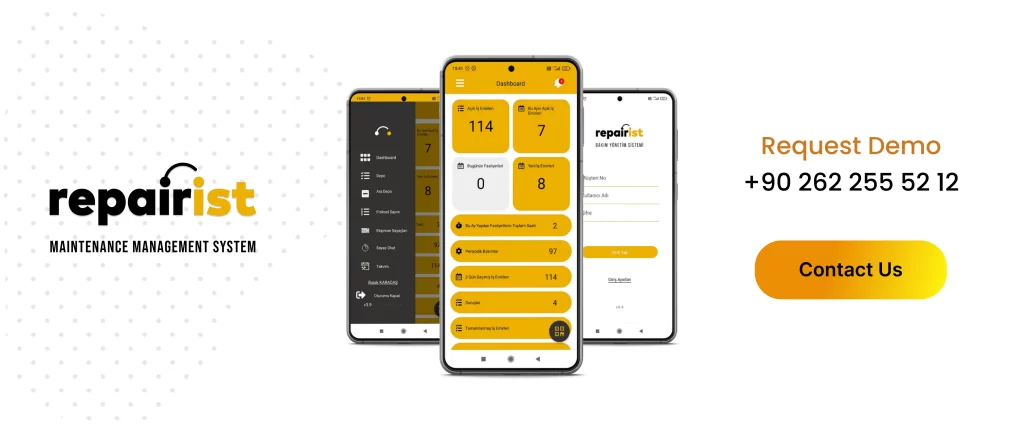
repairist is here to help you. We answer your questions about the Maintenance Management System and provide information about the main features and benefits of the software. We help you access the repairist demo and even get a free trial.
Aybit Technology Inc.